
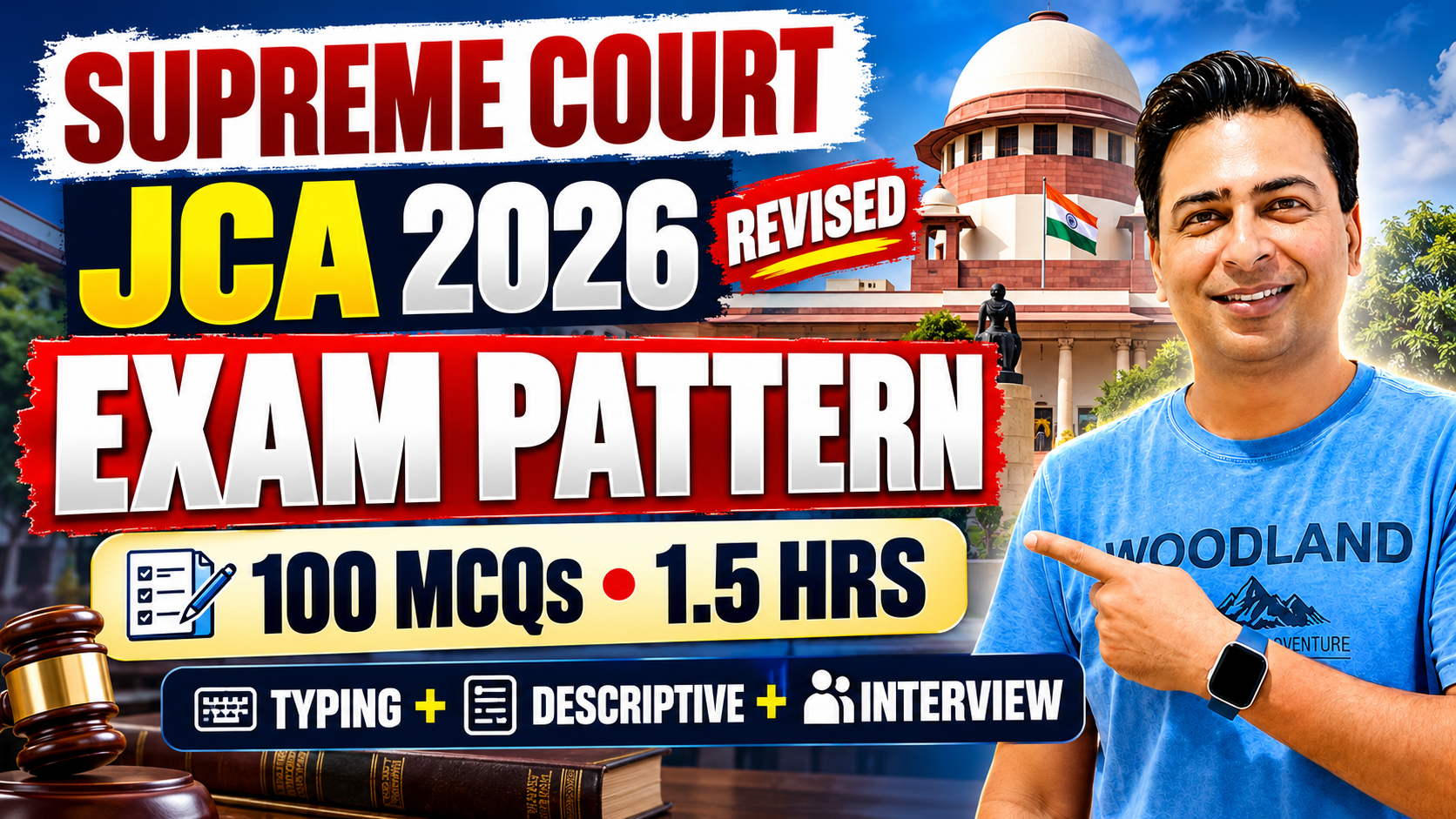
Supreme Court Junior Court Assistant Exam Pattern 2026: Selection Process, Marks & Tests
Looking for the latest Supreme Court Junior Court Assistant Exam Pattern 2026? You are at the right place. This page provides the complete and updated Supreme Court JCA Exam Pattern 2026, subject-wise marks distribution, negative marking, typing speed test, descriptive test, interview, shortlisting criteria and complete selection process.
The Supreme Court Junior Court Assistant Recruitment 2026 selection process is conducted through multiple stages. Candidates first have to appear in the Objective Type Test, followed by the Typing Speed Test on Computer, Written Test (Descriptive) in English and finally the Interview, as applicable under the prescribed selection process.
The first stage is particularly important because the Objective Type Test carries 100 marks and consists of 100 questions. The paper includes General English, General Aptitude, General Knowledge, Judiciary-related provisions of the Constitution, Supreme Court Rules, Officers & Servants Rules and Computer Knowledge.
Candidates should not prepare for the JCA examination by looking only at the first stage. The complete selection process includes typing, descriptive writing and interview stages, so preparation should be planned from the beginning with all stages in mind.
Supreme Court Junior Court Assistant Exam Pattern 2026

📌 Supreme Court JCA Exam Pattern 2026 – Highlights
- ✔ Post: Junior Court Assistant
- ✔ Recruiting Organization: Supreme Court of India
- ✔ Objective Test: 100 Questions
- ✔ Objective Test Marks: 100
- ✔ Objective Test Duration: 1.5 Hours
- ✔ Negative Marking: 0.25 Marks for Each Wrong Answer
- ✔ Minimum Qualifying Marks in Objective Test: 50
- ✔ Typing Speed Test: 50 Marks
- ✔ Typing Test Duration: 10 Minutes
- ✔ Minimum Typing Test Qualifying Marks: 25
- ✔ Minimum Typing Speed: 35 WPM
- ✔ Descriptive Written Test: 100 Marks
- ✔ Descriptive Test Duration: 2 Hours
- ✔ Interview: 25 Marks
- ✔ Interview Minimum Qualifying Marks: 13
- ✔ Total Marks Across Four Stages: 275
⚡ Quick Answer: What is the Supreme Court JCA Exam Pattern 2026?
The Supreme Court Junior Court Assistant Exam Pattern 2026 consists of four major stages:
- Objective Type Test – 100 Marks
- Typing Speed Test on Computer – 50 Marks
- Written Test (Descriptive) in English – 100 Marks
- Interview – 25 Marks
The total marks across these four stages are 275.
The Objective Test has 100 questions for 100 marks with 0.25 negative marking for each wrong answer. Candidates need at least 50 marks to qualify the Objective Test. Shortlisting for the subsequent stages is carried out according to the prescribed merit-based ratio.
📚 Table of Contents
📋 Supreme Court Junior Court Assistant Selection Process 2026
The Supreme Court JCA Selection Process 2026 is not a single-examination recruitment process. Candidates have to clear multiple stages before final selection.
The first stage is the Objective Type Test. Candidates who qualify and are shortlisted according to the prescribed ratio move to the Typing Speed Test and Written Test. Candidates who successfully clear the required stages are then considered for Interview according to the prescribed shortlisting ratio.
🔄 Supreme Court JCA 2026 Selection Flow
⬇
2️⃣ Shortlisting in 1:10 Ratio
⬇
3️⃣ Typing Speed Test + Descriptive Test
⬇
4️⃣ Shortlisting in 1:3 Ratio
⬇
5️⃣ Interview
⬇
🏆 Final Selection
📝 1. Supreme Court JCA Objective Type Test 2026
The Objective Type Test is the first stage of the Supreme Court Junior Court Assistant Examination 2026.
The examination contains 100 objective-type questions carrying 100 marks. Candidates get 1.5 hours to complete the paper.
The Objective Test includes seven different sections. Unlike a typical clerical examination, three sections specifically deal with the Supreme Court and judiciary-related subjects.
| Subject | Questions | Marks |
|---|---|---|
| General English including Comprehension | 20 | 20 |
| General Aptitude | 15 | 15 |
| General Knowledge | 15 | 15 |
| Provisions relating to Judiciary in the Constitution of India | 15 | 15 |
| Supreme Court Rules, 2013 | 10 | 10 |
| Supreme Court Officers & Servants (Conditions of Service and Conduct) Rules, 1961 | 10 | 10 |
| Computer Knowledge | 15 | 15 |
| Total | 100 | 100 |
| Duration | 1.5 Hours | |
📊 Supreme Court JCA Objective Test – Subject-wise Analysis
The distribution of questions is important because candidates should allocate their preparation time according to the weightage of each section.
🔵 High-Weightage Sections
- General English – 20 Questions
- General Aptitude – 15 Questions
- General Knowledge – 15 Questions
- Judiciary in Constitution – 15 Questions
- Computer Knowledge – 15 Questions
🟠 Specialised Sections
- Supreme Court Rules, 2013 – 10 Questions
- Officers & Servants Rules, 1961 – 10 Questions
⚠️ 2. Supreme Court JCA Negative Marking 2026
The Objective Type Test carries negative marking. For every incorrect answer, 0.25 marks are deducted.
What Does This Mean?
Candidates should not blindly guess every question. A good attempt should be based on a balance between speed and accuracy.
- Read the question carefully before marking the answer.
- Use elimination wherever possible.
- Avoid random guessing when you have no idea about the answer.
- Practise mock tests with the same negative-marking rule.
- Analyse accuracy after every mock test.
🎯 Minimum Qualifying Marks – Objective Test
The minimum qualifying marks prescribed for the Objective Type Test are 50 marks.
Candidates should remember that the minimum qualifying marks are not the same thing as the competitive cut-off. Shortlisting depends on merit and the prescribed number of vacancies.
📈 3. 1:10 Shortlisting After Objective Test
If a large number of candidates secure the minimum qualifying marks in the Objective Type Test, the Supreme Court shortlists candidates for the next stage according to the prescribed merit-based ratio.
The advertisement provides for shortlisting of candidates in a 1:10 ratio against the number of tentative vacancies, based on merit, for the Typing Speed Test and Written Test.
What Does 1:10 Mean?
For example, if there are 250 tentative vacancies, a 1:10 ratio corresponds to approximately 2,500 candidates, subject to the actual application of the prescribed rules and merit.
Therefore, candidates should not prepare merely to score the minimum 50 marks. The practical objective should be to obtain a strong competitive score.
⌨️ 4. Supreme Court JCA Typing Speed Test 2026
Candidates shortlisted after the Objective Test have to appear in the Typing Speed Test on Computer.
The Typing Speed Test is conducted in English and carries 50 marks. The test duration is 10 minutes. The minimum qualifying marks are 25.
| Typing Test Parameter | Details |
|---|---|
| Mode | Computer |
| Language | English |
| Duration | 10 Minutes |
| Total Marks | 50 |
| Minimum Qualifying Marks | 25 |
| Minimum Typing Speed | 35 WPM |
| Mistake Tolerance | Up to 3% of total words typed |
What Should You Practise?
- English typing on a physical computer keyboard
- 10-minute timed typing tests
- Accuracy and punctuation
- Continuous typing without unnecessary pauses
- Maintaining at least 35 WPM comfortably
✍️ 5. Supreme Court JCA Written Test – Descriptive 2026
The next important stage is the Written Test (Descriptive) in English. This is different from the Objective Test because candidates have to write structured answers rather than select MCQ options.
The Descriptive Test carries 100 marks and the duration is 2 hours. The minimum qualifying marks are 50.
| Descriptive Test Parameter | Details |
|---|---|
| Language | English |
| Duration | 2 Hours |
| Total Marks | 100 |
| Minimum Qualifying Marks | 50 |
| Comprehension | Included |
| Précis Writing | Included |
| Essay Writing | Included |
Major Components of the Descriptive Test
Comprehension
Candidates need to understand and respond to a given passage.
Précis Writing
Candidates have to demonstrate the ability to summarise written content clearly.
Essay Writing
Candidates need to write a structured and coherent essay in English.
🎤 6. Supreme Court JCA Interview 2026
Candidates who successfully clear the required written stages are shortlisted for the Interview according to the prescribed selection criteria.
The Interview carries 25 marks, and the minimum qualifying marks are 13.
What Can Candidates Prepare For?
- Basic awareness about the Supreme Court of India
- Understanding of the Junior Court Assistant role
- General awareness and current affairs
- Communication skills
- Confidence and professional behaviour
- Questions relating to academic and professional background
Candidates should remember that the Interview is the final assessment stage in the prescribed four-stage selection structure and should not be ignored until the last moment.
🏆 7. 1:3 Shortlisting for Interview
After the Typing Speed Test and Written Test, candidates who have successfully qualified the prescribed tests are shortlisted for Interview according to a 1:3 ratio against the tentative number of vacancies.
For example, against 250 tentative vacancies, a 1:3 ratio would correspond to approximately 750 candidates being shortlisted for Interview, subject to the actual application of the recruitment rules and merit.
This makes every stage important. Candidates cannot depend entirely on their Objective Test performance because subsequent stages determine progression towards final selection.
📊 Supreme Court JCA 2026 – Complete Marks Distribution
| Stage | Marks | Duration | Minimum Qualifying Marks |
|---|---|---|---|
| Objective Type Test | 100 | 1.5 Hours | 50 |
| Typing Speed Test | 50 | 10 Minutes | 25 |
| Written Test – Descriptive | 100 | 2 Hours | 50 |
| Interview | 25 | — | 13 |
| Total | 275 | — | — |
🔎 Supreme Court JCA Selection Process 2026 – Stage by Stage
Stage 1 – Objective Type Test
The recruitment begins with a 100-mark Objective Type Test. Candidates have 1.5 hours to solve 100 questions. The paper contains seven sections and has 0.25 negative marking for each wrong answer.
Stage 2 – Shortlisting in 1:10 Ratio
Candidates who qualify the Objective Test are shortlisted for the next stages in the prescribed 1:10 ratio against tentative vacancies, based on merit.
Stage 3 – Typing Speed Test
Shortlisted candidates appear for a 10-minute English typing test on computer. The test carries 50 marks, with 25 marks as the minimum qualifying requirement and a minimum typing speed of 35 WPM.
Stage 4 – Written Descriptive Test
The Descriptive Test is conducted in English for 2 hours and carries 100 marks. It includes comprehension, précis writing and essay writing.
Stage 5 – Shortlisting in 1:3 Ratio
Candidates who successfully qualify the required stages are shortlisted for Interview in the prescribed 1:3 ratio against tentative vacancies.
Stage 6 – Interview
The Interview carries 25 marks and candidates need at least 13 marks to qualify.
Stage 7 – Final Selection
Candidates who successfully complete the prescribed stages are considered for final selection according to the applicable recruitment rules, merit and vacancies.
⏱️ Time Management in the Objective Test
Candidates get 90 minutes for 100 Objective Test questions. This means time management is extremely important.
| Time | Suggested Activity |
|---|---|
| First 20–25 Minutes | Attempt easy English, GK and Computer questions |
| Next 25–30 Minutes | Aptitude and manageable calculation-based questions |
| Next 25 Minutes | Constitution, Supreme Court Rules and Officers & Servants Rules |
| Last 10–15 Minutes | Review doubtful questions and check marked answers |
This is only a suggested practice strategy. Candidates should develop their own time allocation through mock tests.
🎯 How to Prepare According to the Supreme Court JCA Exam Pattern 2026?
1. Prepare for the Objective Test First
The Objective Test is the first major screening stage, so candidates should build strong command over all seven sections.
2. Do Not Ignore the Specialised Sections
Constitution-related Judiciary provisions, Supreme Court Rules, 2013 and Officers & Servants Rules, 1961 require dedicated preparation.
3. Start Typing Practice Alongside Preparation
Do not wait for the Objective Test result. Practise English typing from the beginning and work towards maintaining a comfortable speed above 35 WPM.
4. Practise Descriptive Writing
Write comprehension answers, précis and essays regularly. Focus on structure, grammar, clarity and time management.
5. Practise Interview Communication
After the written stages, candidates should be prepared to communicate clearly and confidently in the Interview.
6. Take Full-Length Mock Tests
Mock tests should replicate the actual Objective Test conditions, including 100 questions, 90 minutes and 0.25 negative marking.
📚 Stage-Wise Preparation Plan
| Stage | Preparation Focus |
|---|---|
| Objective Test | Syllabus coverage + MCQs + Speed + Accuracy |
| Typing Test | English typing + 10-minute timed practice + Accuracy |
| Descriptive Test | Comprehension + Précis + Essay Writing |
| Interview | Communication + General Awareness + Supreme Court Awareness |
❌ Common Mistakes Candidates Make in JCA Preparation
- Preparing only for the Objective Test and ignoring typing.
- Starting typing practice only after the Objective Test result.
- Ignoring the Descriptive Test until the final stage.
- Preparing only English, Reasoning and GK while ignoring Supreme Court-specific subjects.
- Practising MCQs without considering negative marking.
- Preparing only to cross the 50-mark minimum instead of targeting a competitive score.
- Not practising 10-minute typing tests.
- Not practising précis and essay writing under a time limit.
- Ignoring Interview preparation until the last stage.
- Not analysing mock-test mistakes.
🚀 Prepare for Every Stage of Supreme Court JCA 2026
Our Supreme Court Junior Court Assistant Master Guide 2026 is designed to help candidates prepare the important Objective Test subjects with detailed notes, MCQs, explanations and quick revision material.
📖 Complete Supreme Court JCA 2026 Guide
For complete information about the recruitment, eligibility, syllabus, exam pattern, salary, selection process and preparation strategy, visit our detailed Supreme Court JCA guide.
👉 Read Complete Supreme Court JCA Guide 2026❓ Frequently Asked Questions (FAQs) – Supreme Court JCA Exam Pattern 2026
Q1. What is the Supreme Court Junior Court Assistant Exam Pattern 2026?
The Supreme Court JCA selection process includes an Objective Type Test, Typing Speed Test on Computer, Written Test (Descriptive) in English and Interview, subject to the prescribed shortlisting and qualifying conditions.
Q2. How many questions are asked in the JCA Objective Test?
The Objective Type Test contains 100 questions for 100 marks.
Q3. What is the duration of the Supreme Court JCA Objective Test?
The Objective Type Test duration is 1.5 hours.
Q4. Is there negative marking in Supreme Court JCA Exam 2026?
Yes. 0.25 marks are deducted for every incorrect answer in the Objective Type Test.
Q5. What are the minimum qualifying marks in the Objective Test?
The minimum qualifying requirement is 50 marks out of 100.
Q6. What is the typing speed required for Supreme Court JCA?
The prescribed minimum typing speed is 35 words per minute on computer in English.
Q7. How many marks is the Typing Speed Test?
The Typing Speed Test carries 50 marks and has a duration of 10 minutes. The minimum qualifying marks are 25.
Q8. What is included in the Descriptive Test?
The Written Test is in English and includes comprehension, précis writing and essay writing. It carries 100 marks and the duration is 2 hours.
Q9. What are the minimum qualifying marks in the Descriptive Test?
The minimum qualifying marks are 50 out of 100.
Q10. How many marks is the Interview?
The Interview carries 25 marks, with 13 marks as the minimum qualifying requirement.
Q11. What is the 1:10 shortlisting ratio?
Candidates who qualify the Objective Type Test are shortlisted for the Typing Speed Test and Written Test in a 1:10 ratio against tentative vacancies, based on merit and the prescribed conditions.
Q12. What is the 1:3 shortlisting ratio?
Candidates who successfully qualify the required stages are shortlisted for Interview in a 1:3 ratio against tentative vacancies, as prescribed in the recruitment process.
Q13. What are the total marks in the Supreme Court JCA selection process?
The four stages together carry 275 marks: 100 marks Objective Test + 50 marks Typing Test + 100 marks Descriptive Test + 25 marks Interview.
Q14. Should I start typing practice before the Objective Test?
Yes. Candidates should start typing practice from the beginning rather than waiting for the Objective Test result. Building a reliable 35+ WPM speed requires regular practice.
Q15. Where can I get Supreme Court JCA study material?
You can prepare with the Supreme Court Junior Court Assistant Master Guide 2026 containing 228+ pages, 800+ MCQs, detailed explanations and quick revision material.
🏆 Conclusion
The Supreme Court Junior Court Assistant Exam Pattern 2026 consists of multiple stages, and candidates should prepare for the complete selection process rather than focusing only on the Objective Test.
The first stage is the 100-mark Objective Type Test with 100 questions and 1.5 hours duration. It carries 0.25 negative marking for each incorrect answer and requires a minimum of 50 marks to qualify.
Candidates shortlisted in the prescribed 1:10 ratio proceed to the Typing Speed Test and Written Test. The Typing Test carries 50 marks and requires a minimum speed of 35 WPM, while the Descriptive Written Test carries 100 marks and includes comprehension, précis and essay writing.
Candidates qualifying the required stages are shortlisted for Interview in the prescribed 1:3 ratio. The Interview carries 25 marks and requires 13 marks to qualify.
The total marks across the four stages are 275. Therefore, the best strategy is to prepare Objective Test subjects, typing, descriptive writing and interview skills simultaneously instead of waiting for one stage to finish before starting the next.
📖 Related Supreme Court JCA Articles
- Supreme Court Junior Court Assistant Guide 2026
- Supreme Court Junior Court Assistant Eligibility 2026
- Supreme Court Junior Court Assistant Salary 2026
- Supreme Court Junior Court Assistant Syllabus 2026
- Supreme Court Junior Court Assistant Exam Pattern 2026
- Supreme Court Junior Court Assistant Exam Date 2026
- Supreme Court Junior Court Assistant Cut Off 2026
- Supreme Court Junior Court Assistant Previous Year Paper
- Supreme Court Junior Court Assistant Online Form 2026
- Supreme Court Junior Court Assistant Admit Card 2026
- Supreme Court Junior Court Assistant Result 2026
🚀 Stay Connected With Prashant Chaturvedi
Supreme Court JCA 2026 ke latest updates, exam notifications, admit card, answer key, result, cut-off, preparation strategy, study material aur important government exam updates ke liye humse connected rahen.
🌐 Website 📚 Courses 💬 WhatsApp ▶️ YouTube ✈️ Telegram 📸 Instagram 👍 Facebook 𝕏 X / Twitter🔔 Follow us on social media and never miss an important Supreme Court JCA 2026 update!
Prashant Chaturvedi | Exam Preparation & Career Guidance
© 2026 Prashant Chaturvedi. All Rights Reserved.